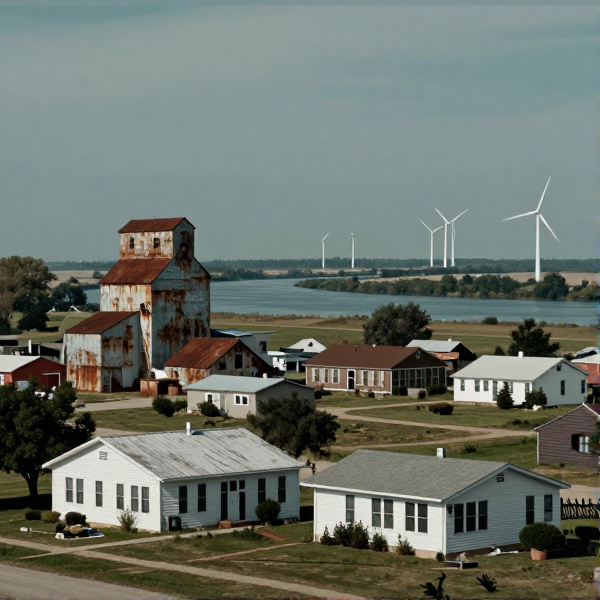
The Silicon Prairie: A Interview on Sizzling Entropy#
Location: A repurposed industrial warehouse in Des Moines, Iowa. The space is a blend of high-end minimalist aesthetics—exposed brick, polished concrete, and glass partitions—contrasted with the heavy, savory aroma of smoked meat hanging in the air.
Participants:
- Maya Veld: A tech journalist for Modern Infrastructure Monthly.
- Elias Thorne: Founder and CEO of Midwest IT.
Maya Veld: (Adjusting her recorder) We’re sitting here in the heart of what’s being called the “Silicon Prairie.” The atmosphere here is… distinctive. It’s a mix of high-frequency trading vibes and a breakfast diner. Elias, thanks for having me. Let’s start with the core problem. You often speak about the “lie” of modern computing.
Elias Thorne: (Leaning forward, eyes intense) Most people think computers are unpredictable. They aren’t. They’re deterministic. When you ask a computer to generate a “random” number, it’s actually just following a complex math formula. We call that pseudorandomness. It’s a sequence, Maya. If I know the seed and the formula, I can predict the future. In the world of high-level encryption, predictability is a death sentence.
Maya Veld: So, how have you solved that? I’ve heard rumors about other companies using environmental entropy, things like the movement of lava lamps or atmospheric noise.
Elias Thorne: (A small, proud smile plays on his lips) We thought about the lava lamps. They’re charming, but they’re slow. They lack… visceral complexity. We decided to go with something more fundamental to the human experience. We use bacon.
Maya Veld: (Pauses, pen hovering over her notepad) Bacon?
Elias Thorne: Specifically, we’ve developed Baconprint. It’s entropy-as-a-service. We don’t just “use” bacon; we capture the inherent chaos of the cooking process. Every single strip of bacon is biologically unique, like a fingerprint. The length, the width, the marbling, the fat distribution, the cellular structure, the shape are each different but the real magic happens in the transition from raw to cooked.
Maya Veld: Walk me through the technical pipeline. How does a breakfast staple become an encryption certificate?
Elias Thorne: It’s a rigorous multi-stage process. First, we take a raw strip. Then, we subject it to a controlled thermal environment. The way the fat renders, the way the proteins contract—that’s pure, non-deterministic physics. We then use high-resolution optical sensors to map the surface of the cooked strip.
Maya Veld: And then?
Elias Thorne: We convert those visual maps into a complex waveform, essentially a 3D topographical map of the “sizzle.” That waveform is then digitized into a raw binary string. We take that massive string of numbers and use it as the primary seed for an encryption certificate. Because no two strips of bacon cook in the exact same way, no two certificates are ever the same.
Maya Veld: I noticed some heated discussion in the breakroom earlier. Was that about the tech?
Elias Thorne: (Chuckling) That was the Great Debate. The engineering team is currently split between “Crispy” and “Chewy.” The Crispy faction argues that the jagged, fractured edges of the meat provide a more “high-frequency” entropy. The Chewy faction believes the gradual, elastic rendering of the fat offers a more “robust” data set. Honestly, the fact that our lead developers are willing to go to war over the texture of pork actually helps our randomness. It creates a diversity of inputs that a purely algorithmic approach just can’t replicate.
Maya Veld: (Laughing) It’s a very… literal interpretation of “human input.” And what happens to the bacon once the data is harvested?
Elias Thorne: We have a policy of “Zero Waste Entropy.” Once a strip has been fully digitized and its waveform has been converted to binary, it’s technically “spent” data. Our support team gets to enjoy the physical remains. We call it “digitized bacon.” It’s a huge morale booster.
Maya Veld: (Smirking) I can see why. But let’s talk about the business side. This feels like a brilliant marketing move - appealing to your rural, heartland demographic with a product that feels like home. Was that the primary driver?
Elias Thorne: (His expression shifts to something more contemplative, slightly weary) It was. It was a marketing success. We wanted to show that “high tech” didn’t have to mean “cold and alien.” It could be grounded. But, in the spirit of transparency, we did underestimate the logistical friction of the move toward Post-Quantum Cryptography (PQC).
Maya Veld: Explain that for our readers.
Elias Thorne: With PQC, the industry is moving toward much more frequent certificate rotations. We’re talking about certificates that need to be refreshed constantly to stay ahead of quantum threats. Because our entropy source, the bacon, requires a physical process, the sheer volume of strips we have to cook, scan, and digitize to keep up with those rotation speeds is… substantial. Our “marketing stunt” is now a massive industrial logistics operation. We’re basically running a high-tech charcuterie factory that doubles as a data center.
Maya Veld: (Smiling) It’s an ambitious pivot. So, looking at the big picture, how is the business actually doing?
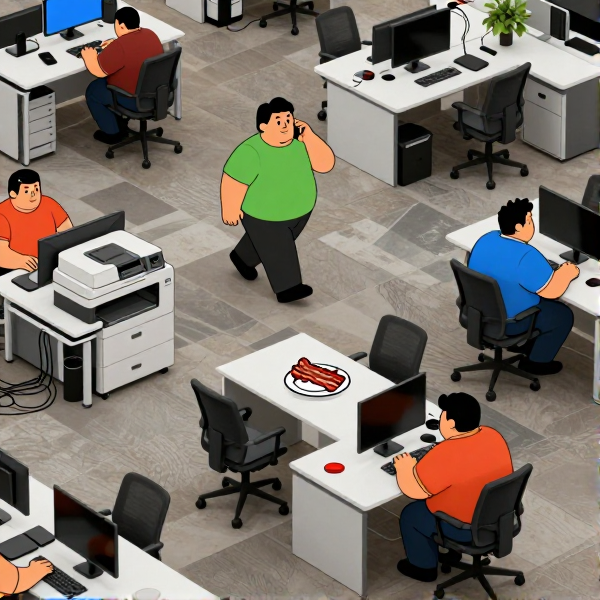
Elias Thorne: Business is good. We have a steadily growing client base, and we’re filling a real need here in the Silicon Prairie. People want security they can trust, and they like the “Baconprint” story. For some reason, our health insurance premiums have been increasing significantly every year, even faster than other businesses I talk to. Other than that, business is doing well.
Maya Veld: That’s great to hear, Elias. And thank you for your time for this interview.
Elias Thorne: My pleasure. Feel free to tke some bacon on your way out.
Written with Gemma 4 12b QAT with the following prompt: Create a realistic fictionalized story about a midwest tech startup based on these notes. The story is mostly told as a back-and-forth interview between a journalist and an IT office founder. IT founder complains about pseudorandom not being truly random. Founder: “You might have heard of other companies using lava lamps or other things. Well, we use bacon.” Founder explains in detaill: Baconprint (random number generator for encryption) (like fingerprint but using bacon) Every bacon strip is unique and then made even more unique in how it cooks. The bacon is the converted to a waveform which is the converted to binary. The numbers from sheet of bacon then is used as the seed for an encryption certificate. “There is some contention among the team between crispy versus chewy bacon but that just helps add to the randomness.” The support team the gets to eat the bacon after its “digitized”. The concept was a marketing stunt to appeal to the rural base but did not take into consideration the frequent certificate rotation that would come with post-quantum cryptography. (Ending) Journalist: “How is business doing?” Founder: “Business is good. We have a steadily growing client base and are filling a real need here in the Silicon Prairie. For some reason, our health insurance premiums have been increasing significantly every year, even faster than other businesses I talk to. Other than that, business is doing well.” Journalist: “That’s great to hear and thank you for your time for this interview.”