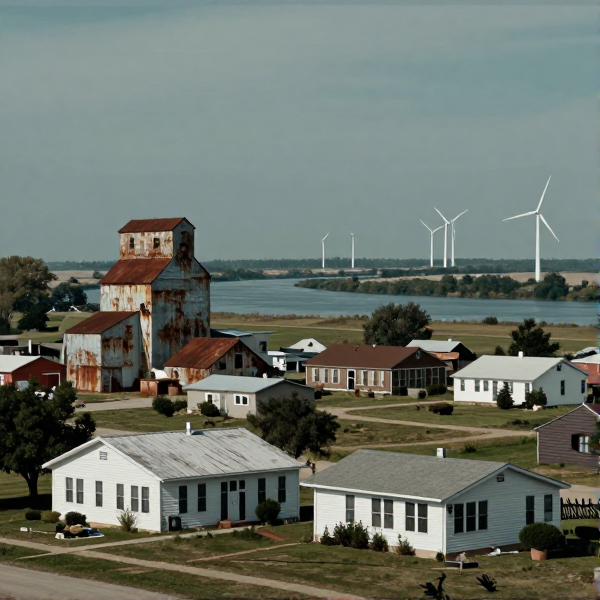
The wind didn’t start as a roar; it began as a vibration.
Ben sat in his small living room, the glow of his dual monitors illuminating a workspace cluttered with lithium-ion cells, multi-meters, and various portable power stations. On his screen, a video editing suite showed the rough cuts of his latest upload: “Why LiFePO4 is the King of Off-Grid Storage.”
He had moved to Oakhaven Junction three years ago for the same reasons his followers often joked about: the “post-industrial peace.” It was a town that had stopped moving in the 1980s. The houses were mid-century survivors, their siding graying like old hair, and the silence of the nights was profound. For a remote software engineer, it was a sanctuary. For a man who spent his weekends obsessing over battery chemistry, it was a laboratory.
Then, the barometer on his desk plummeted.
The sky outside shifted from a bruised purple to a sickly, necrotic green. The wind shifted, moving from a moan to a rhythmic, violent thrum that made the windows rattle in their frames. This wasn’t just a summer storm. It was a derecho, a wall of wind that had been carving its way across the plains.
The lights flickered once, twice, and then died.
The silence that followed was even heavier than the wind. Then came the sound: a deep, subterranean groan of timber and metal protesting. Ben stood, his heart hammering. He grabbed his “Go-Bag”—a heavy-duty kit containing his most reliable power stations, several foldable solar panels, and a hand-crank radio.
Outside, the world was screaming.
By 2:00 AM, the storm had passed, leaving behind a world that felt tilted on its axis. Ben stepped onto his porch. The air was thick with the smell of wet dirt and pulverized pine. A massive oak from the neighboring yard lay across his driveway, and the road leading toward the county seat was choked with debris.
He walked to the edge of the road and saw the hazard. The creek, usually a trickle, had become a raging torrent. It had undermined the old stone bridge—the only artery out of town. It hadn’t collapsed entirely, but the center span had buckled, rendering it impassable for anything larger than a bicycle.
Oakhaven Junction was an island.
A low moan came from the house next door. Ben recognized it as Mrs. Gable. She lived alone, and her husband had passed two years ago. She had a portable oxygen concentrator that required a constant power source, and her refrigerator held the only food she had for the week.
Ben didn’t hesitate. He grabbed his largest power station—a 2000Wh unit he’d nicknamed “The Beast”—and headed out.
He wasn’t the only one moving. In the dim moonlight, the town was waking up. People were stepping out onto porches, faces pale, looking at the downed lines and the blocked roads.
“Ben?” a voice called out. It was Miller, the owner of the hardware store. He was standing by his truck, looking at the bridge. “Road’s gone. Power’s out. My generator’s flooded in the basement.”
“I’ve got some juice,” Ben shouted over the wind. He held up his power station. “I can keep some things running. But we need to get people together. If we stay in our houses, we’re just waiting for the food to spoil or the batteries to die.”
The plan formed with the frantic logic of survival. The Oakhaven K-8 school sat on the hill—a sprawling, empty brick carcass. It was the largest roof in town, and because it was abandoned, it was the only place they could gather in one place.
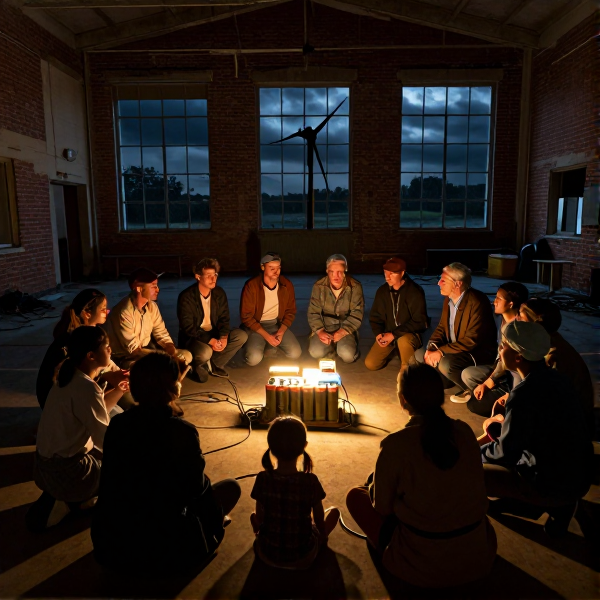
By 4.00 AM, forty people were huddled in the school’s gymnasium. It was a haunting sight: children’s ghosts seemed to linger in the empty lockers, while the living huddled in rows of folding chairs.
The atmosphere was thick with a mixture of fear and weary determination.
“We need to save the meat,” Mrs. Gable whispered, her oxygen concentrator humming steadily, plugged into one of Ben’s smaller units.
“The school chest freezer appears to still be working,” Miller announced. “If we can get the groceries into one place, we can keep them cold longer by grouping them together.”
The townspeople moved with a collective purpose. They hauled bags of groceries from various cars—canned goods, bags of flour, and crates of meat. They moved them into the school’s cafeteria, where Miller had set up the chest freezer. They were creating a communal larder, a fortress against the looming threat of hunger.
Ben, meanwhile, was being treated as a sort of “Power Wizard.” He had set up a “Charging Station” in the center of the gym. He had his folding solar panels laid out on the roof of the gymnasium (which had a slight southern tilt), but the clouds were thick. The sun wouldn’t be enough.
“We’re going to run out of juice in twelve hours,” Ben told the group. He looked at the new construction site on the north side of town—the Apex Renewable Complex. “The factory has the components. They have high-output wind turbines in the staging area. If we can get some parts, we can build a makeshift array to catch the wind.”
“That’s miles away,” someone shouted. “And the roads are blocked!”
“The woods are clear,” Ben said, pointing to the dense treeline behind the school. “We don’t need the road. We need a team.”
The journey to the factory was a grueling trek through mud and fallen timber. They moved in a line—the able-bodied carrying the elderly and the children. They moved like a community that had forgotten it was a “decaying” town and remembered it was a “surviving” one.
When they reached the Apex site, the sight was imposing. Massive steel towers stood like sentinels. The factory was dark, but the staging area was filled with crates.
Under the direction of Miller—who knew every bolt and bracket of industrial hardware—and Ben, who understood the circuitry, they began to scavenge. They didn’t need the whole turbines; they needed the nacelles, the small-scale DC motors, and the heavy-duty cabling.
They hauled the components back to the school. For the next six hours, the gym transformed into a workshop. The “Batteries with Ben” guy was no longer reviewing products; he was engineering a lifeline.
They rigged four scavenged DC motors onto sturdy timber frames. They positioned them on the roof of the school, facing the prevailing wind direction. They wired the outputs back to Ben’s massive battery bank.
“It’s going to draw a huge surge,” Ben warned, his hands shaking as he tightened a terminal. “If the voltage spikes, it’ll fry the batteries.”
“Then we throttle it,” Miller said, holding a set of pliers.
They flipped the switch.
At first, there was only the sound of the wind whistling through the blades. Then, the motors groaned. The wires began to hum. A small digital readout on Ben’s primary battery bank began to climb.
Charging… 1%… 2%…
A cheer went up from the gym—a raw, primal sound of victory.
By dawn, the sun broke over the horizon, turning the gray mud into a shimmering gold. The power wasn’t back on the grid, but the school was glowing.
Ben’s batteries were full. They had enough power to run the oxygen concentrators, the communal refrigerator, and a few string lights that bathed the gymnasium in a warm, amber hue.
People sat on the floor, sharing coffee and bread. They weren’t just neighbors anymore; they were a tribe. They had spent the night huddled in a tomb of a school, saved by a man with a YouTube channel and a pile of batteries, and fueled by the very technology that was supposed to be the town’s future.
Miller looked at the spinning turbines on the roof, then at the massive factory looming in the distance.
“You know,” Miller said, his voice thick with emotion. “I used to think that factory was just going to be another job that chewed our people up and spat them out. But I think it’s something else.”
Ben looked at his battery bank, the steady hum of the wind-charged cells providing a heartbeat for the town. He thought about his “Batteries with Ben” audience, who often asked if renewable energy was enough to sustain a life.
He looked at Mrs. Gable, who was breathing easily. He looked at the kids, who were safe and fed.
“It’s not just energy, Miller,” Ben said softly. “It’s independence.”
The town of Oakhaven Junction wasn’t just a rust-belt relic anymore. In the glow of the scavenged turbines, it had become something new: a place that knew how to hold its own when the world went dark.
Written with Gemma 4 12b QAT with the following premise: Create a short story (aim for 4-10 pages in length without adding unnecessary fluff) about a rural, Midwest town of 1,000 people that goes through a major nighttime storm (tornado, derecho, just wind, they can only speculate) and loses power and connectivity with the outside world. The main character, Ben, who usually keeps to himself and moved to the town for its low cost of living and resilience to climate change after his job allowed people to work remotely, runs a YouTube channel on the side called ‘Batteries with Ben’ where he reviews household and portable batteries. It’s a very specific topic. He has a few sets of portable solar panels as part of testing the batteries. Come up with a reason that people can’t just leave the town (Bridge washed away, trees blocking the road, etc.). The story should involve Ben offering the batteries he has to his neighbors (ventilator, refrigeration, etc.) to last until the power can be restored. They consolidate to the abandoned school, using a chest freezer there to consolidate food, and eventually explore the new factory to find parts for wind turbines, which they construct a few to recharge the batteries. The story ends with the town building quite a community together and appreciating the resilience and independence of renewable energy, which gives a real heart to the new factory.
The end result wasn’t bad butheistory t could be a lot better. Granted I only let it do one pass and didn’t offer any feedback revisions. Most obviously, the timeline needed to be stretched out and the stakes made clear that power wasn’t coming back from the outside anytime soon. You’re probably going to start in the morning with the sunrisinstead of 2am e and wait a little bit before you start consolidating food. I also wanted Ben to hand out more batteries to people and thestruggle to n keep them charged, getting to know people and their needs as he went.
I did like the town profile that it put together for the setting first. By establishing the setting first, the story could create within expectations.
Town Profile: Oakhaven Junction, Iowa Population: ~1,000
Current Status: Transitioning (Rust-Belt Decay → Renewable Energy Hub)
- The Atmosphere: “The Fading Glow” Oakhaven Junction is a town of stark contrasts. It carries the heavy, gray atmosphere of a community that has been “waiting” for thirty years. The air still smells faintly of damp earth and manure from the surrounding livestock farms, but there is a new, metallic tang of ozone and welding sparks on the northern edge of town.
The town feels like a photograph that has been left in the sun: the colors are slightly washed out, and the edges are frayed. You see it in the “Weathered Modern” aesthetic—houses with 1960s ranch-style silhouettes and 1980s siding, now showing cracked foundations and peeling paint. The grass in the front yards is often tall, a byproduct of a dwindling tax base that makes municipal maintenance a secondary priority.
The Economic Pivot For decades, Oakhaven was a “slow-motion” town. The grain elevators still stand as skeletal monuments to the past, but the local coop is struggling. However, the horizon has changed. On the outskirts, federal funding has sparked the construction of the “Apex Renewable Complex.” Massive solar arrays and wind turbine assembly plants are rising out of the cornfields, bringing in a new demographic: transient contractors, engineers, and a steady stream of heavy-duty freight trucks.
Amenities & Infrastructure Downtown Area (The “Main Street” Strip) The Aesthetic: A single stretch of cracked asphalt lined with buildings from the 1960s and 70s. Most storefronts have “For Lease” signs or are occupied by “ghost businesses”—spaces that house storage or small private workshops.
Key Landmarks:
The Rusty Anchor: A diner that serves as the town’s de facto social club. The neon sign flickers, but the coffee is still hot.
Miller’s Hardware: A sagging brick building that serves as the only place to buy industrial supplies; it functions as the town’s unofficial headquarters for community news.
Traffic Flow: Almost exclusively Stop Signs. There are no traffic lights in the downtown core. The “Stop” signs are often rusted, and the intersection at the town center is wide enough to accommodate semi-trucks, but the white paint on the ground has been nearly erased by tires.
The Grocery Store
The “Oakhaven Market”: Rather than a full-scale supermarket, this is a hybrid between a convenience store and a small co-op.
Inventory: It stocks the essentials—milk, bread, beer, and meat—but the “fresh produce” section is small and often contains items from the neighboring farms. It is the town’s primary lifeline for food, and it serves as the primary hub for residents to see who else is around.